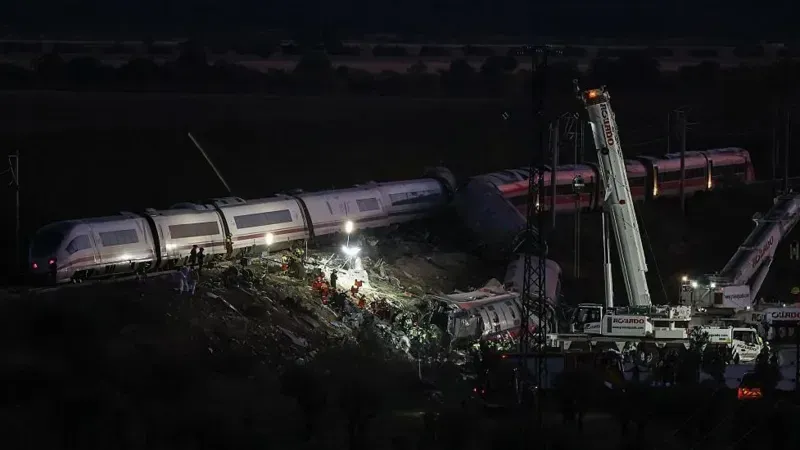
Spain begins 3 days of mourning after deadly train crash
Spain has begun three days of national mourning after at least 68 people died and dozens were injured in a major train crash. It is one of the deadliest rail disasters in modern European history.
Rescue workers spent the night searching through twisted metal and damaged train carriages under powerful floodlights. Emergency teams used heavy equipment to reach people trapped inside the wreckage. Drones and helicopters also helped search the area and move debris.
Many of the victims had still not been identified by Wednesday night.
The crash happened on Wednesday morning when a train travelling from Madrid to Seville hit another train that had stopped on the tracks.
Spanish Prime Minister Pedro Sánchez said the entire country was grieving. He said families had been torn apart and the pain caused by the disaster was enormous.
Hundreds of emergency workers have been sent to the crash site to help with rescue and recovery efforts.
Investigators examine what went wrong
Officials are working to find out why the two trains collided.
Spain’s transport minister, Óscar Puente, said the stationary train was operated by private company Iryo and had 147 passengers on board. It had stopped because of a computer system failure, he said.
When such a failure happens, a control centre in Madrid is supposed to take charge. However, Puente said the centre made an “inexplicable” decision to allow the trains to move again without speed restrictions.
Audio recordings between train controllers and drivers appear to show that one high-speed train was allowed to continue even though another train ahead had stopped.
Iryo said its train was hit from behind by a train operated by state-owned company Renfe. The Renfe train was carrying 397 passengers.
The force of the collision sent several carriages down an embankment. Witnesses described passengers crying and bleeding, people trapped in their seats, and smoke filling the damaged carriages. One carriage caught fire.
Investigators are examining the events leading up to the crash as families wait for answers.
Anger and questions over railway safety
Prime Minister Sánchez said it was unacceptable that Spain had suffered two major rail disasters in the same year.
In January, a high-speed train crash near Córdoba killed 46 people. That accident happened on the same railway line, although much farther south.
The latest disaster has raised fresh questions about the safety of Spain’s rail network.
Most political parties stopped campaigning for upcoming elections following the crash. However, the far-right party Vox said it would continue its political activities.
Vox leader Santiago Abascal argued that mourning should not be used to stop people from criticising the country’s railway system.
Around 1,500 people gathered outside Spain’s Transport Ministry in Madrid overnight, according to Spanish broadcaster TVE. Many called for the resignations of Sánchez and Puente.
Police used tear gas to disperse the crowd after some protesters threw bottles and flares. No injuries or arrests were reported.
Meanwhile, the Spanish railway drivers’ union, Semaf, said a planned strike on Thursday would go ahead. The union said the action was intended to defend railway safety.
Alberto Núñez Feijóo, leader of the main opposition People’s Party, said the public deserved to know what was happening with the country’s transport infrastructure.
Families search for missing relatives
Relatives of passengers on both trains spent Wednesday trying to find information about their loved ones.
Spain’s Civil Guard opened offices in Madrid, Toledo, Seville and Córdoba to help investigate reports of missing people.
Authorities said identifying victims was a major priority. They are collecting DNA samples to help match missing people with their relatives.
In Toledo, people gathered for a vigil and observed a minute of silence to remember those who died.
Messages of support have also arrived from across Europe. European Union flags in Brussels were lowered to half-mast as a sign of solidarity with Spain during the mourning period.
The crash is Spain’s deadliest rail disaster since 2013, when 80 people died in a train accident near Santiago de Compostela in the north-west of the country.
As rescue workers continue their efforts, the country is mourning the victims while investigators work to establish exactly what caused the collision.